Jul 14, 2025
CompanyHow governments are replacing paper documents with digital credentials
What if you could vote from abroad, prove your age without showing your ID, or access government services without waiting in line? Digital credentials are making this happen.
Albania had a problem. Over 1.6 million citizens lived abroad, far from polling stations, unable to participate in elections. The traditional solution would require them to travel home, take time off work, spend money on flights. Most didn't bother. Then Albania tried something different: digital voter registration through a smartphone app.
The result? A 525% increase in diaspora participation. Over 245,000 citizens registered to vote from wherever they lived, completing identity verification on their phones and receiving a digital voter card they could present at consulates worldwide. No flights required. No paperwork lost in the mail. Read the full story: Albanian diaspora voter registration surges 525% with Folio Wallet
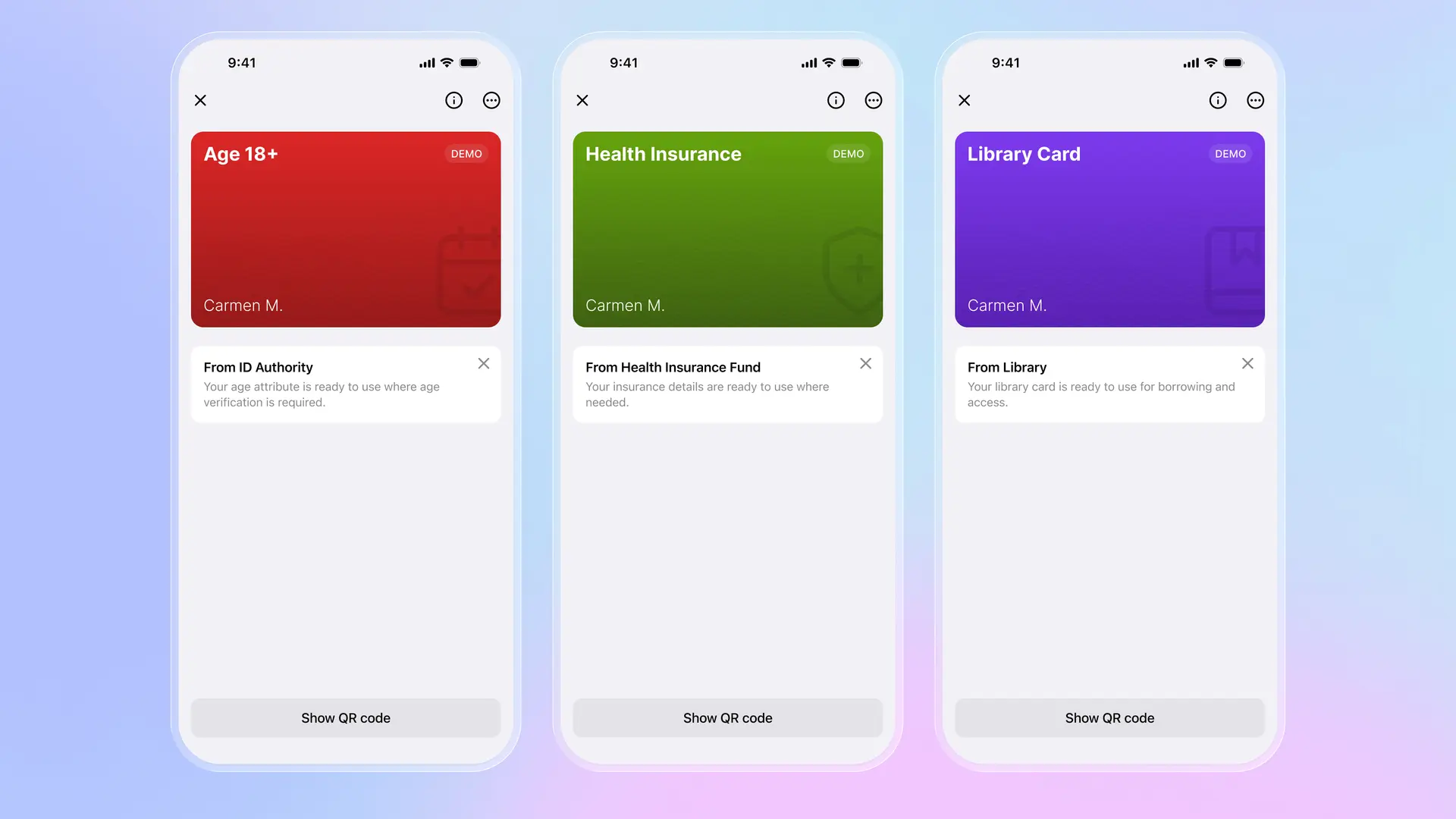
This is what digital credentials make possible. Not just scans of paper documents, but cryptographically signed proofs that can be verified instantly, shared selectively, and never forged. A digital credential proving you're over 18 doesn't reveal your exact birthday. A digital voter card confirms your registration status without exposing your home address. The holder controls what information gets shared.
What changes for citizens
Think about every time you've interacted with government. Applying for a permit. Proving eligibility for a benefit. Showing your ID at a border crossing. Each interaction typically involves physical documents, in-person visits, and waiting. Digital credentials transform these moments.
Access from anywhere. Government services stop being tied to physical locations. A citizen living abroad can renew a driver's license, register for an election, or apply for benefits without flying home. Rural residents access the same services as those in capital cities.
Share only what's needed. When a bar checks your age, they don't need to know your address or driver's license number. When you prove vaccination status for travel, you shouldn't have to share your entire medical history. Digital credentials enable this selective disclosure by design.
Instant verification. No more waiting for someone to call a database, review a document, or check if a credential is still valid. Verification happens in seconds, cryptographically, without requiring human judgment or back-office processing.
Where this is already working
Voting and civic participation. Beyond Albania, multiple countries are exploring digital credentials for elections. The goal is the same: enable citizens to participate in democracy regardless of where they live, while maintaining the security and integrity elections require.
Benefits and social services. Governments distribute pensions, disability benefits, healthcare subsidies, and welfare payments. Each program needs to verify recipient identity and eligibility. Digital credentials reduce fraud while making access easier, replacing physical benefit cards that can be lost or stolen.
Professional licensing. Doctors, lawyers, architects, contractors: professionals need to prove their qualifications to employers, clients, and regulators. Paper certificates can be forged. Database lookups are slow. Digital credentials let a professional present a verified qualification that anyone can check instantly.
Healthcare. Proving insurance coverage, accessing medical records, confirming vaccination status: healthcare involves constant identity verification. Digital credentials speed up these checks while protecting patient privacy. When you visit a new doctor, they confirm your insurance eligibility without seeing your employment history or home address.
Travel and border control. Digital visas, pre-clearance credentials, trusted traveler status: borders are natural use cases for verifiable credentials. The EU's upcoming EUDI Wallet will let citizens cross borders with digital credentials accepted in all member states.
Why governments are moving this direction
The benefits aren't just for citizens. Governments adopting digital credentials see measurable improvements in operations.
Fraud drops dramatically. Paper documents can be forged. Databases can be hacked. Digital credentials use cryptography that makes forgery mathematically infeasible. When Albania issued digital voter cards, they could be verified with certainty, unlike paper registration documents that might be altered or counterfeited.
Costs decrease. Physical offices, printing equipment, staff reviewing documents, postage: the infrastructure of paper-based government is expensive. Digital processes reduce these costs while handling more transactions. A citizen renewing a credential through an app costs a fraction of what an in-person visit costs.
Data quality improves. When credentials flow directly from authoritative sources, errors from manual data entry disappear. The professional license in a doctor's wallet comes directly from the licensing board, not from a form someone typed.
Inclusion expands. Citizens with mobility limitations, those in remote areas, and diaspora populations gain access to services that previously required physical presence. Government services become available to everyone, not just those who can visit offices during business hours.
The challenges that remain
Digital credentials aren't a magic solution. Real implementation requires solving real problems. Not everyone has a smartphone. Not everyone is comfortable with digital tools. Governments must provide alternatives and support varying levels of digital literacy.
Privacy concerns are legitimate. Citizens need assurance that digital systems protect their information better than paper processes, not worse. The technology supports this through selective disclosure and decentralized design, but governments must demonstrate these protections clearly.
Legal frameworks often lag technology. Many jurisdictions need legislation to give digital credentials the same legal status as physical documents. This is changing, with the EU's eIDAS regulation leading the way, but it takes time.
Standards matter for interoperability. A credential issued in one country should be verifiable in another. International standards like W3C Verifiable Credentials and ISO 18013 for mobile driver's licenses provide this foundation, but adoption varies.
What comes next
The direction is clear. The EU is requiring all member states to offer digital identity wallets by 2026. Countries across the world are piloting digital credentials for specific use cases. Citizens increasingly expect digital-first government services, especially after the pandemic accelerated digital adoption.
Folio works with governments to make this transition happen. Our platform handles the full credential lifecycle: secure issuance, citizen-controlled storage, and instant verification. The Albania voter registration is one example. The technology applies equally to benefits distribution, professional licensing, travel documents, and any other credential a government issues.
The transformation won't happen overnight, but it's happening. Paper documents served us for centuries. Digital credentials will serve us better. Learn more about Folio's solutions for government.
Keep reading
Best identity verification platforms in 2025
Research
Dec 19, 2025
Best identity verification platforms in 2025
Research
Dec 19, 2025
The EU is giving everyone a digital ID wallet. Here's what that means.
Product
Oct 25, 2025
The EU is giving everyone a digital ID wallet. Here's what that means.
Product
Oct 25, 2025
How NFC chip scanning verifies your passport in seconds
Business
Oct 20, 2025
How NFC chip scanning verifies your passport in seconds
Business
Oct 20, 2025