Feb 11, 2025
BusinessDocument intelligence: AI-powered document processing explained
Document intelligence uses AI to automatically classify, extract, and verify information from documents. Learn how this technology streamlines business processes and improves compliance.
Every day, businesses process thousands of documents: bank statements, utility bills, tax forms, registration certificates, proof of address, and countless other paperwork. Manually reviewing these documents is slow, expensive, and error-prone. Document intelligence applies artificial intelligence to automate this work, extracting information accurately and at scale.
Unlike traditional OCR (Optical Character Recognition) that simply converts images to text, document intelligence understands documents. It identifies document types, locates relevant fields, extracts structured data, and validates that information against expected patterns and external sources.
Beyond OCR: what document intelligence does
Traditional OCR technology emerged decades ago to digitize printed text. While useful, it has significant limitations: it extracts raw text without understanding context, struggles with poor image quality, and requires extensive manual configuration for each document type.
Document intelligence builds on OCR with additional capabilities:
Automatic classification: The system identifies what type of document it's looking at, whether that's a bank statement, utility bill, tax return, or corporate registration. This happens automatically, without requiring users to specify document types in advance.
Intelligent extraction: Rather than returning a wall of text, the system extracts specific fields: names, addresses, account numbers, dates, amounts. It understands document layouts and knows where to find relevant information.
Data validation: Extracted data is checked for consistency and plausibility. Does the date format make sense? Is the address properly structured? Do numerical values fall within expected ranges?
Fraud detection: AI models can identify signs of document manipulation: inconsistent fonts, irregular spacing, evidence of digital editing, or metadata anomalies that suggest tampering.
Document types and use cases
Document intelligence handles a wide range of document categories:
- Identity documents: Passports, national ID cards, driver's licenses. Extract personal details and verify document authenticity.
- Proof of address: Utility bills, bank statements, government correspondence. Verify current address and confirm residency.
- Financial documents: Tax returns, pay stubs, bank statements. Assess income and financial standing.
- Corporate documents: Business registrations, articles of incorporation, shareholder records. Verify company information and ownership.
- Vehicle documents: Registration certificates, insurance cards. Confirm vehicle ownership and coverage.
- Healthcare documents: Insurance cards, medical records. Verify coverage and process claims.
The business value of automation
Manual document review creates significant costs and bottlenecks. Consider a loan application process where staff must review bank statements, verify income, and confirm address. Each application might require 30 minutes or more of human review time.
Document intelligence transforms this process:
Speed: Documents are processed in seconds rather than minutes. Applications that took days can complete in hours.
Accuracy: AI extraction reduces human errors from misreading or mistyping information. Validation catches inconsistencies that tired reviewers might miss.
Scalability: Processing capacity scales without proportional headcount increases. Handle seasonal peaks without temporary staff.
Consistency: Every document is evaluated against the same criteria. No variation between reviewers or across time of day.
Audit trails: Automated systems create complete records of what was checked and what was found, simplifying compliance reporting.
Handling document quality challenges
Real-world documents rarely arrive in perfect condition. Users photograph documents with their phones, resulting in varied lighting, angles, and image quality. Document intelligence must handle these challenges gracefully.
User guidance: Good systems help users capture better images. On-screen guides show optimal positioning, lighting warnings alert when conditions are poor, and automatic capture triggers when image quality meets thresholds.
Image preprocessing: AI models can correct for rotation, perspective distortion, and uneven lighting before extraction. This improves accuracy even when source images are imperfect.
Confidence scoring: Rather than simply returning extracted values, document intelligence provides confidence scores indicating how certain the system is about each extraction. Low-confidence extractions can be flagged for human review.
Multiple attempts: Systems can allow users to retry document capture if initial quality is insufficient, with specific feedback about what needs improvement.
Fraud detection capabilities
Document fraud takes many forms, and document intelligence helps detect them:
Digital manipulation: Signs that a PDF or image has been edited using software. This includes metadata inconsistencies, compression artifacts, and pixel-level anomalies.
Physical tampering: Evidence that a printed document has been altered, such as tape marks, cut edges, or replaced elements.
Template mismatches: Documents that don't match known templates from the supposed issuing organization. A fake bank statement might have incorrect logos, wrong fonts, or unusual layouts.
Data inconsistencies: Information that doesn't make sense in context. An address that doesn't exist, dates in wrong formats for the region, or amounts that don't add up correctly.
Document intelligence with Folio
Folio's document intelligence platform combines automatic classification with intelligent extraction and validation. The system accepts documents through secure upload interfaces with built-in guidance to help users capture quality images.
Document intelligence
Automatically review submitted documents to confirm identity or validate proof of address, income, or health with minimal effort.
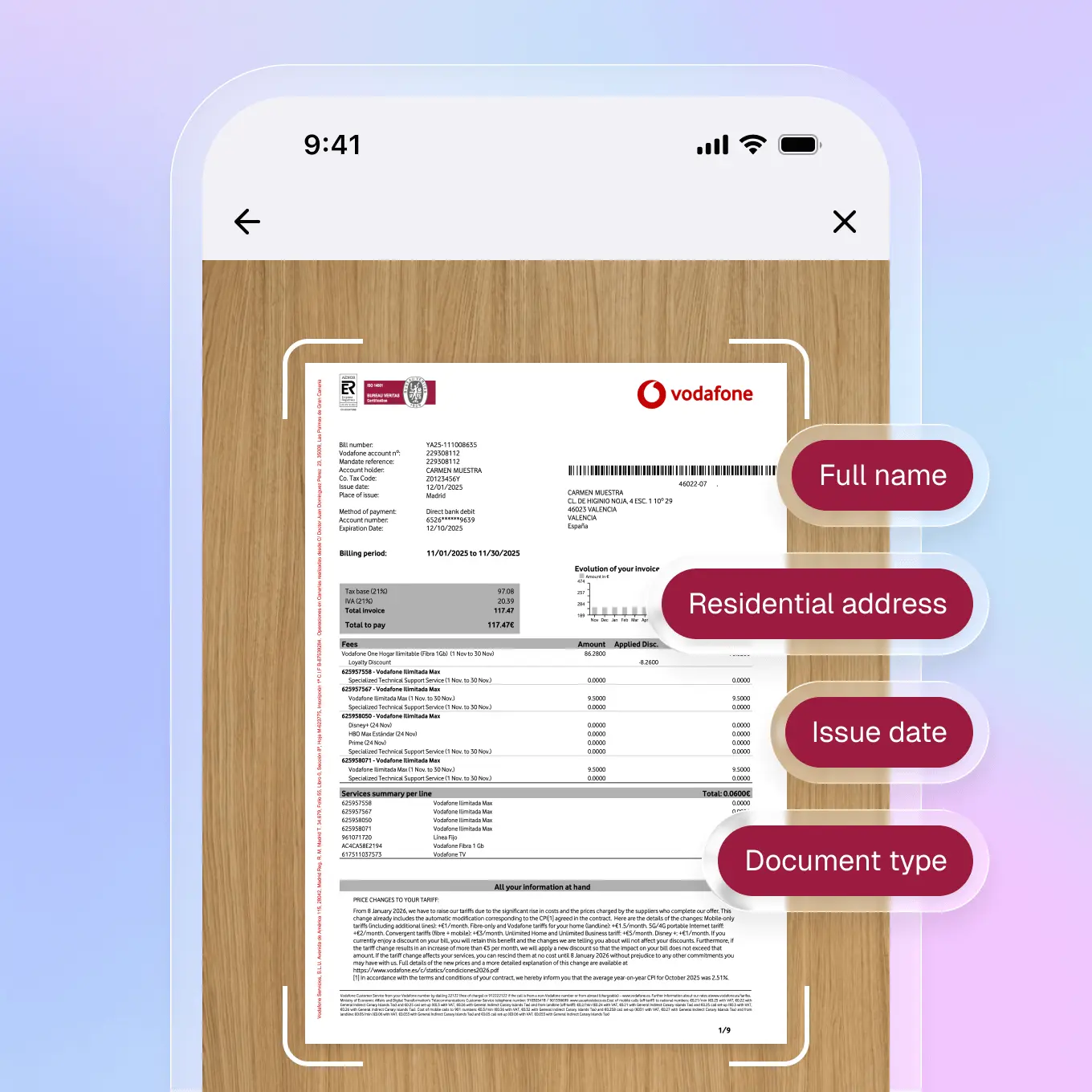
AI models classify incoming documents automatically and extract relevant fields based on document type. Configurable tamper detection identifies signs of manipulation, while confidence scores highlight extractions that may need human review.
For businesses, document intelligence integrates with broader identity verification workflows. Proof of address documents can verify customer residence, financial documents can support risk assessments, and corporate documents can confirm business relationships. The result is faster processing, lower costs, and stronger compliance.
As businesses handle increasing document volumes with growing regulatory requirements, document intelligence provides the automation needed to scale operations without sacrificing accuracy or compliance. The technology continues advancing, with new models improving accuracy and supporting additional document types across more countries and languages.
Keep reading

Best identity verification platforms in 2025
Research
Dec 19, 2025
Best identity verification platforms in 2025
Research
Dec 19, 2025

The EU is giving everyone a digital ID wallet. Here's what that means.
Product
Oct 25, 2025
The EU is giving everyone a digital ID wallet. Here's what that means.
Product
Oct 25, 2025

How NFC chip scanning verifies your passport in seconds
Business
Oct 20, 2025
How NFC chip scanning verifies your passport in seconds
Business
Oct 20, 2025